
You notice it every year around autumn. Your skin starts feeling different, a little tighter, a little rougher, a little more reactive than it was a month ago. You reach for a richer moisturiser, and it helps for an hour. Then the tightness comes back. Sound familiar?
Here is what is actually happening. When the season shifts, your skin faces three separate challenges at three different layers. Cell turnover slows at the surface. Lipid production drops in the middle layers.
And your barrier, the protective wall between your skin and the world, starts letting moisture escape. Each of these has its own cause and its own effect. Knowing the difference between them changes everything about how you care for your skin through the cooler months. This is your evidence-based guide to what autumn skin barrier and cell turnover changes really mean, and why the answer goes deeper than your moisturiser.
Why Does Cell Turnover Slow Down in Cooler Weather?
Your skin is always renewing itself. Old cells move up from the deeper layers, flatten out, and shed from the surface. This process is called desquamation, it is just a word for skin cell shedding. In healthy skin, it takes about 28 days. But cooler temperatures slow this cycle down.

Research published in the British Journal of Dermatology (Rawlings et al., 2004) found that lower temperatures reduce the activity of enzymes that help your skin shed old cells. Those enzymes need a certain level of moisture in the outer skin layer to work properly. When autumn air gets drier and cooler, that moisture drops, and the enzymes slow down. Old cells pile up instead of shedding cleanly.
The result is visible. Your skin looks duller. The texture feels rougher. Fine lines look more obvious because dead cells are sitting in them.
This is not your skin ageing faster. It is your skin's natural renewal process running behind schedule. Understanding how exfoliation fits into this process can help you work with your skin's rhythm rather than against it.
The key insight here is that texture build-up in autumn is a surface problem with a specific cause. It is not fixed by adding more moisture on top. It is addressed by supporting the shedding process itself.
Key Takeaways
- When autumn arrives, three things happen to your skin at once.
- Cell turnover slows down, causing texture build-up on the surface.
- Lipid production drops, creating gaps in your skin barrier that let moisture escape.
- And a weakened barrier makes your skin more reactive and sensitive.
- These are three separate problems happening in three different layers of your skin.
What Happens to Your Skin's Lipid Barrier When Temperature Drops?
Below the surface, something else is happening. Your skin produces natural fats called lipids, think of them as the mortar between the bricks of your outer skin layer. These lipids include ceramides, cholesterol, and fatty acids. Together they form a protective structure that holds moisture in and keeps irritants out.

Cold, dry air disrupts this structure in two ways. First, your skin produces fewer lipids in cooler conditions. Second, low humidity pulls moisture out of your skin faster than it can be replaced.
A study in the Journal of Investigative Dermatology (Fluhr et al., 2001) showed that transepidermal water loss (TEWL), the rate at which water escapes through your skin, rises in low-humidity environments. When lipid levels drop, the barrier develops gaps. Moisture escapes through those gaps constantly.
This is the real reason your skin feels tight by midday even after you moisturise in the morning. A moisturiser adds water. But if your lipid barrier has gaps, that water escapes within hours.
You are refilling a leaking container. The leak itself needs to be addressed. Understanding the difference between dry and dehydrated skin is a useful next step here, because lipid loss and water loss are related but not the same thing.
Ceramides are the most important lipid in this barrier. They make up about 50% of the lipid content in your outer skin layer. When ceramide levels fall in autumn, the barrier's ability to hold its structure weakens greatly.
How Does a Weakened Barrier Make Skin More Reactive and Sensitive?
Here is where things connect. When your barrier has gaps, it does not just lose moisture. It also lets things in that should stay out. Pollutants, irritants, allergens, and even the fragrance in your favourite product can now reach skin layers they normally would not reach. Your skin's immune cells respond. swelling follows.

This is why autumn often brings a spike in reactive skin. Products you used all summer without any issue suddenly sting or cause redness. Your skin is not changing its mind about those products.
Your barrier is just less able to buffer against them. Research by Elias and Feingold (2001) in Archives of Dermatology describes this clearly: barrier disruption triggers an causing swelling response as the skin tries to repair itself. That response makes skin more sensitive while repair is underway.
For anyone whose skin already tends toward reactivity, this seasonal shift can feel major. The sensitivity is real. But it has a structural cause, a barrier with reduced lipid content and slower cell turnover. Addressing those two underlying issues, rather than just avoiding every potential trigger, is what actually builds resilience over time. Stress also plays a role in barrier function, and autumn's lifestyle changes can compound the skin's response.
This also explains why the same person can have oily skin in summer and reactive, tight skin in autumn. Skin type is not fixed. It responds to its environment.

Why a Heavier Moisturiser Is Not the Whole Answer
This is the part that most seasonal skincare advice misses. Switching to a richer cream in autumn is not wrong. But it only addresses one of the three mechanisms we have covered.
A heavier moisturiser adds water-binding ingredients and some occlusive protection. It does not speed up cell turnover. It does not rebuild your lipid barrier from within.
Think of it this way. You have three problems: a slow shedding process at the surface, gaps in your lipid barrier in the middle layers. And a reactive response from a compromised barrier. A heavy moisturiser sits on top and helps reduce water loss.
That matters. But the dead cell build-up underneath it is still there. The lipid gaps are still there. The barrier is still letting irritants through.
Addressing each layer means thinking about each mechanism separately. Supporting cell turnover at the surface. Replenishing the lipids that form the barrier structure. And then, yes, also protecting against water loss from outside.
These are three different jobs. They need to be approached as three different jobs. What happens to skin in winter follows the same logic, the seasonal shift is a process, not a single event.
The good news is that your skin is designed to repair itself. It just needs the right support at each layer to do so efficiently.
What Does This Mean for Sensitive Skin just?
If your skin already tends toward sensitivity, autumn is the season where that sensitivity often peaks. The three mechanisms above all hit at once. Slower cell turnover means more old cells sitting on the surface, which can trap products and increase reactivity. Lipid loss means a weaker barrier with less buffering capacity. And the causing swelling response from barrier disruption makes skin more prone to reacting to things it normally tolerates.
Research on sensitive skin consistently points to barrier function as the central factor. A 2016 review in Journal of the European Academy of Dermatology and Venereology (Farage et al.) found that reduced barrier function is present in most people who describe their skin as sensitive. Autumn does not create sensitive skin. But it does amplify the underlying patterns that were already there.
Understanding your own sensitivity pattern matters here. Some people react because of genetic differences in how their skin produces ceramides. Others react because of microbiome changes or a history of over-exfoliation. The seasonal shift exposes whichever weakness is already present. Knowing how active ingredients interact with reactive skin becomes especially relevant during this transition period.
The seasonal shift is not something to fear. It is information. Your skin is telling you exactly which layer needs support right now.
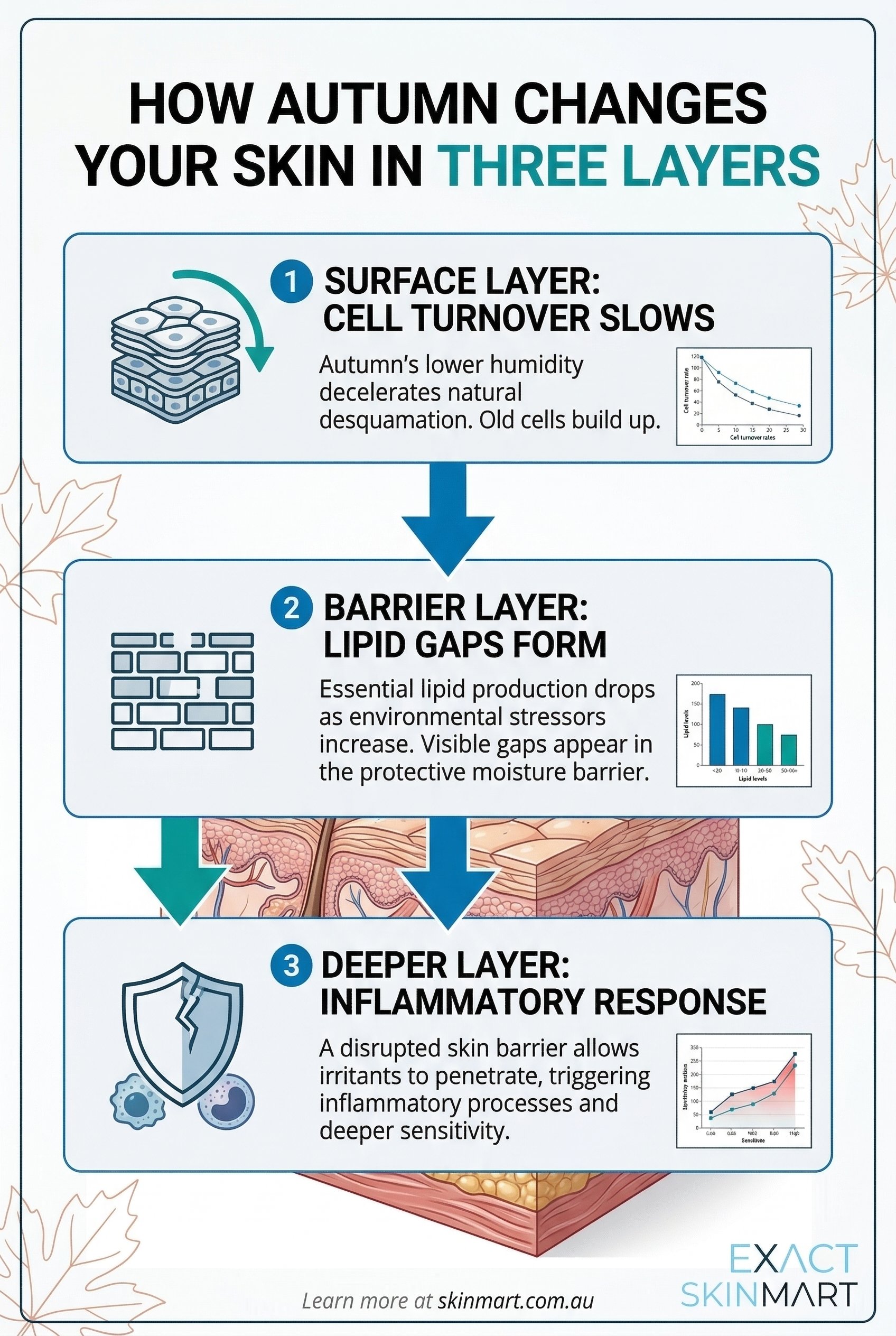
Autumn is not just a cue to grab a heavier cream. It is a signal that three things are changing in your skin at the same time. Cell turnover slows at the surface, causing texture build-up. Lipid production drops in the barrier layers, creating gaps that let moisture escape.
And a compromised barrier makes your skin more reactive to everything around it. Each of these is a separate mechanism. Each needs a different kind of support.
The most empowering thing you can do right now is understand which layer is asking for help. Your skin is not breaking down. It is responding to its environment in a completely predictable way. And once you understand the pattern, you can stop guessing and start responding to what your skin actually needs. If you want to understand your specific sensitivity pattern and what it means for your seasonal routine, starting your Skin Blueprint™ is the clearest path forward.


