
You made it through summer. Your skin survived the heat, the beach days, the long evenings outside. Then March arrives, the air cools down, and your skin decides to break out. Not a small blemish or two.
A proper wave of congestion across your chin, jaw, or cheeks. And the frustrating part? Your skin feels less oily than it did in January. So what is going on?
This is one of the most common skin patterns we see in Australia. And it makes complete sense once you understand what summer actually does to your skin beneath the surface. Autumn breakouts are not random. They are not a sign that your routine has stopped working.
They are a delayed response to months of heat, UV exposure. And barrier stress that built up quietly while you were busy enjoying the warmer months. Here are seven things worth knowing about acne this season.
Why Does Summer Cause Autumn Breakouts?
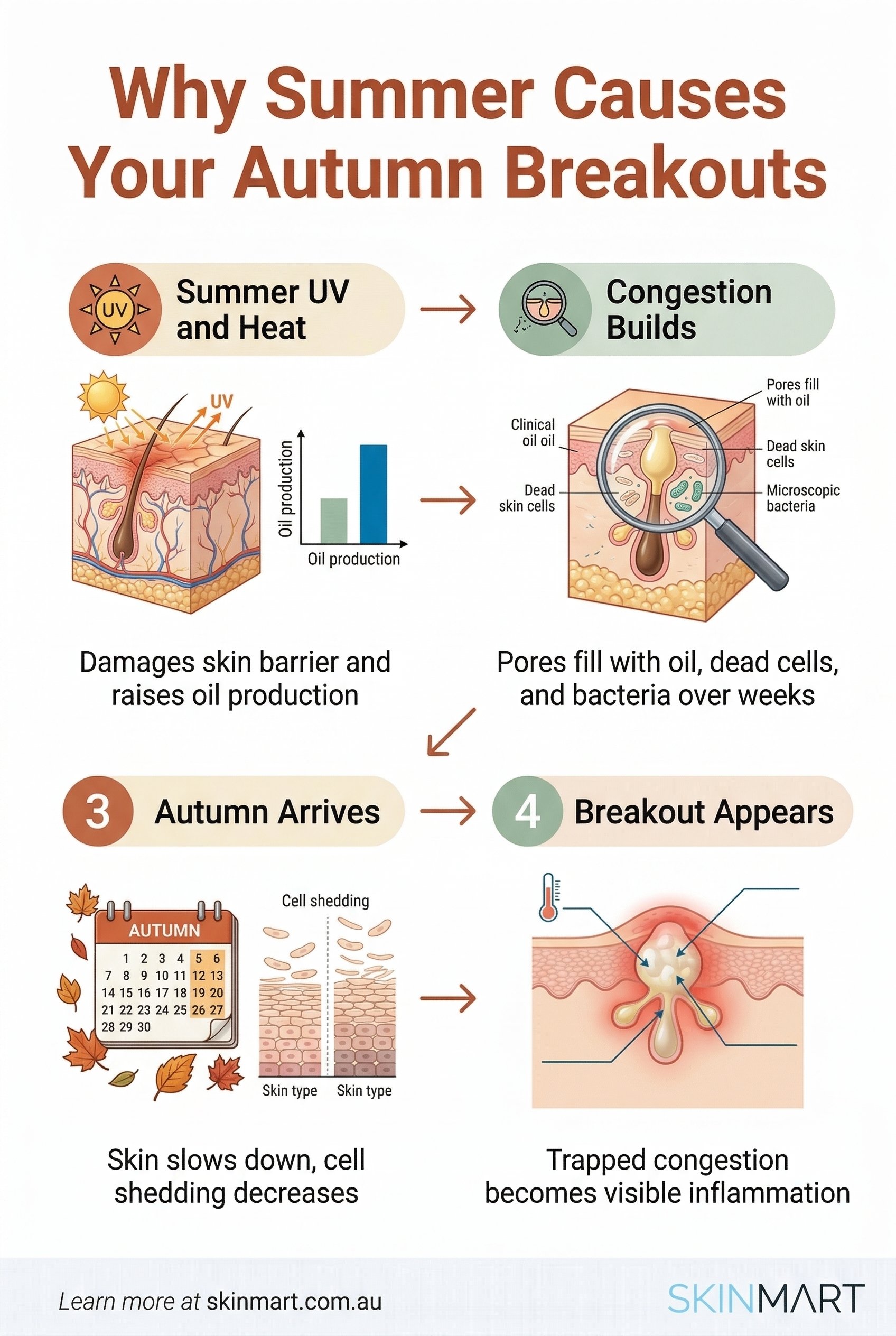
Here is the key idea: skin damage from summer does not always show up straight away. UV rays and heat create swelling deep inside your skin. That swelling quietly damages your barrier, the outer layer of skin that keeps moisture in and irritants out. But you do not see the result for weeks, sometimes longer.
Think of it like a sunburn that goes deeper than the surface. The redness fades, but the damage to your skin cells lingers. Over summer, your pores also produce more oil (called sebum) to cope with the heat.
Dead skin cells build up faster. When autumn arrives and your skin starts to slow down, all that congestion gets trapped. The result is a wave of breakouts that feels completely out of place for the cooler season.
This delayed pattern is why autumn acne catches so many people off guard. The trigger was summer. The breakout is autumn. Your skin is not reacting to the cold air. It is finishing a process that started months earlier.
Why Does My Skin Feel Less Oily But Still Break Out?
This is the part that confuses almost everyone. Cooler weather slows down your oil glands. So your skin genuinely does produce less sebum in autumn than in summer. You might even feel like your skin is finally behaving. But breakouts keep coming, and that feels like a contradiction.

The reason is that acne is not just about how much oil your skin makes right now. It is about what is already sitting inside your pores. Over summer, excess oil, dead skin cells, and bacteria built up inside your follicles.
That congestion is already there. Cooler, drier air in autumn actually makes it harder for your skin to shed those blocked cells naturally. So the pores stay clogged even as oil production drops.
There is also a shift in how your skin sheds dead cells, a process called desquamation (your skin's natural cycle of releasing old cells to make way for new ones). In summer, heat speeds this process up. In autumn, it slows.
That slowdown means old cells linger longer and block pores more easily. Less oily does not mean less congested. Understanding how exfoliation fits into this cycle can make a real difference to how your skin clears through the season.
Key Takeaways
- Autumn breakouts happen because summer heat and UV damage your skin's barrier over weeks.
- By the time autumn arrives, that hidden damage shows up as congestion and acne.
- Your skin may feel less oily in cooler weather, but the pores are still blocked from months of swelling.
- Seasonal shifts also change your skin's oil production, cell turnover rate, and moisture levels.
- Understanding these changes helps you respond to what your skin actually needs, not just what the season looks like on the su...
What Does UV Damage Actually Do to Your Skin's Barrier?
Your skin barrier is made up of cells and natural fats called ceramides (think of them as the mortar between the bricks of your outer skin layer). This barrier keeps moisture locked in and keeps bacteria and irritants out. UV rays break down ceramides over time. After a full Australian summer, your barrier is often weaker than you realise.
A weakened barrier means your skin loses water faster. It also means bacteria that cause acne, especially Cutibacterium acnes, can get deeper into your pores and trigger more swelling. Research published in the Journal of Investigative Dermatology has shown that UV exposure increases skin swelling markers and disrupts the lipid structure of the barrier. This sets up the exact conditions that lead to breakouts weeks later.
Heat alone, separate from UV, also triggers swelling. When your skin is hot for extended periods, it produces more of a substance called substance P, a chemical that signals your sebaceous glands to make more oil. More oil plus a damaged barrier equals congested, breakout-prone skin heading into autumn. Learning the difference between dry and dehydrated skin helps you understand exactly what your barrier is going through during this shift.
Is Seasonal Acne Different From Regular Acne?
Acne is acne in terms of how it forms. A blocked pore fills with oil and dead skin cells. Bacteria multiply inside it. Your immune system responds with swelling. That process is the same whether you are 16 or 44, and whether it is summer or autumn.

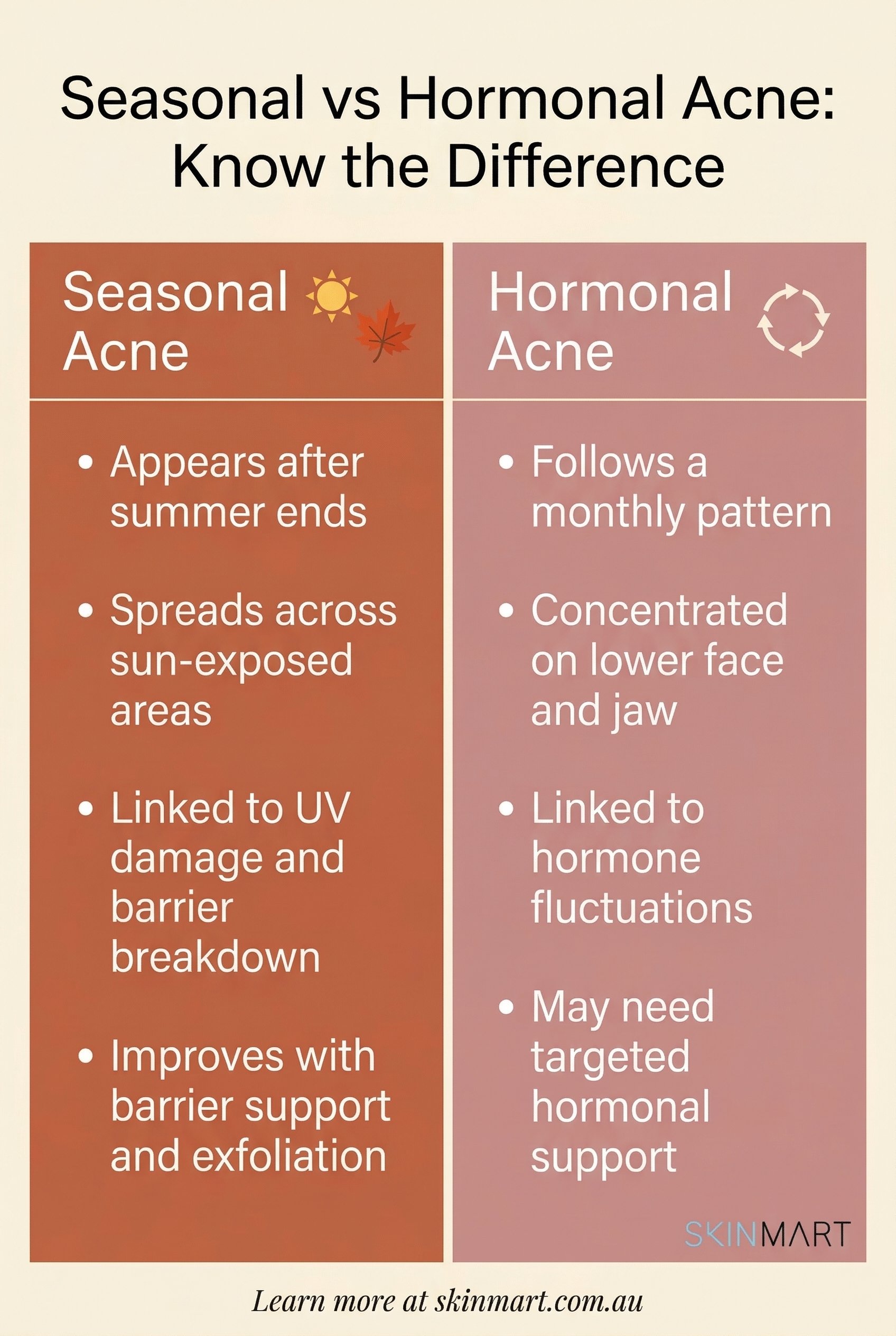
But the triggers are different, and that matters for how you respond. Hormonal acne tends to appear in the same spots each month, usually the lower face and jaw. Stress-related breakouts often appear when cortisol levels are high and your barrier is already compromised.
Stress has a direct effect on your skin that goes beyond just feeling run-down. Seasonal acne, by contrast, tends to appear more broadly across areas that were most exposed to sun and heat. And it follows the pattern of summer ending.
Knowing which type of acne you are dealing with changes your approach. Seasonal breakouts often respond well to gentle barrier support and consistent exfoliation. Hormonal breakouts may need a different strategy entirely. If your breakouts follow a monthly pattern regardless of season, that is worth exploring separately from the autumn factor.
Does Diet Play a Role in Autumn Breakouts?
The short answer is yes, for some people. The evidence around diet and acne has grown greatly over the past decade. High-glycaemic foods, the ones that spike your blood sugar quickly, have been linked to increased acne in multiple studies. A 2007 study in the American Journal of Clinical Nutrition found that a low-glycaemic diet led to fewer breakouts over 12 weeks compared to a control diet.
Autumn also brings a shift in eating habits for many people. Warmer, heavier foods replace salads and cold meals. Social eating around Easter and school holidays can mean more processed foods and sugar. These changes do not cause acne on their own, but they can add to the causing swelling load your skin is already managing after summer. There are specific dietary patterns worth knowing about if you suspect food is helping to your breakouts.
Dairy is another factor that research has explored. Some studies suggest a link between milk consumption and acne, maybe due to hormones present in dairy. The evidence is not conclusive for everyone, but it is worth paying attention to your own patterns. The chocolate and acne question is also worth reading if you have wondered about that connection.
How Does Your Skin's Circadian Rhythm Affect Seasonal Breakouts?
Your skin has its own internal clock. It repairs itself mostly at night and defends itself during the day. This rhythm is tied to light exposure, temperature, and sleep patterns. In summer, longer days and later sunsets shift this rhythm.
Sleep often gets shorter. Evening UV exposure continues later into the day. Your skin's repair cycle gets compressed.
When autumn arrives and daylight shortens again, your skin's rhythm resets. This reset period is a transition, and transitions create instability. Oil production, cell turnover, and swelling responses all adjust at slightly different rates. That mismatch creates a window where your skin is more reactive and prone to congestion. Understanding how your skin's daily rhythm works gives you a real advantage in supporting it through seasonal shifts.
Better sleep in autumn is genuinely good for your skin. During deep sleep, your skin produces more growth hormone, which helps repair barrier damage from summer. If your sleep improved when the cooler weather arrived, your skin will benefit from that too, even if it does not show straight away.
What Should You Actually Do Differently in Autumn?
The most useful shift you can make in autumn is to support your barrier while keeping your pores clear. These two goals can feel like they pull in opposite directions, but they do not have to. The key is choosing products and habits that do both without tipping too far either way.
Gentle, consistent exfoliation helps your skin shed the congestion left over from summer. This does not mean aggressive scrubbing. It means supporting your skin's natural cell turnover with a well-chosen exfoliant used regularly. At the same time, switching to a slightly richer moisturiser helps rebuild the ceramide layer that UV broke down over summer. Your skin needs both, not one or the other.
Sunscreen does not stop in autumn. Australian UV remains high through March, April, and into May. The UV index regularly sits at 3 or above in most Australian cities through autumn.
This is enough to cause ongoing barrier damage if you stop protecting your skin. Keeping SPF in your morning routine year-round is one of the most evidence-backed habits in skincare. If you are also dealing with breakout marks left from summer, there are specific approaches for treating acne marks that are worth knowing about before you choose a treatment.
Autumn breakouts are not a mystery once you understand the timeline. Summer sets the stage with heat, UV damage, and excess oil production. Autumn reveals the result as your skin slows down and all that congestion becomes visible.
Your skin is not broken. It is responding to months of stress in a completely predictable way. And that means it is also completely manageable once you know what you are working with.
The most powerful thing you can do right now is stop guessing and start understanding. Not every breakout has the same cause, and not every solution fits every skin. If you are tired of reacting to your skin instead of getting ahead of it, that is exactly the shift we are here to help you make. Start with understanding your skin fully, and the right approach will follow from there.


