If you have reactive skin, you've probably built a careful routine around what to leave out. No fragrance. No sulfates.
No harsh actives. And that discipline matters, removing known irritants is a smart first step. But if your skin still flares, still feels tight, still reacts to things it shouldn't, avoidance alone isn't the full answer.
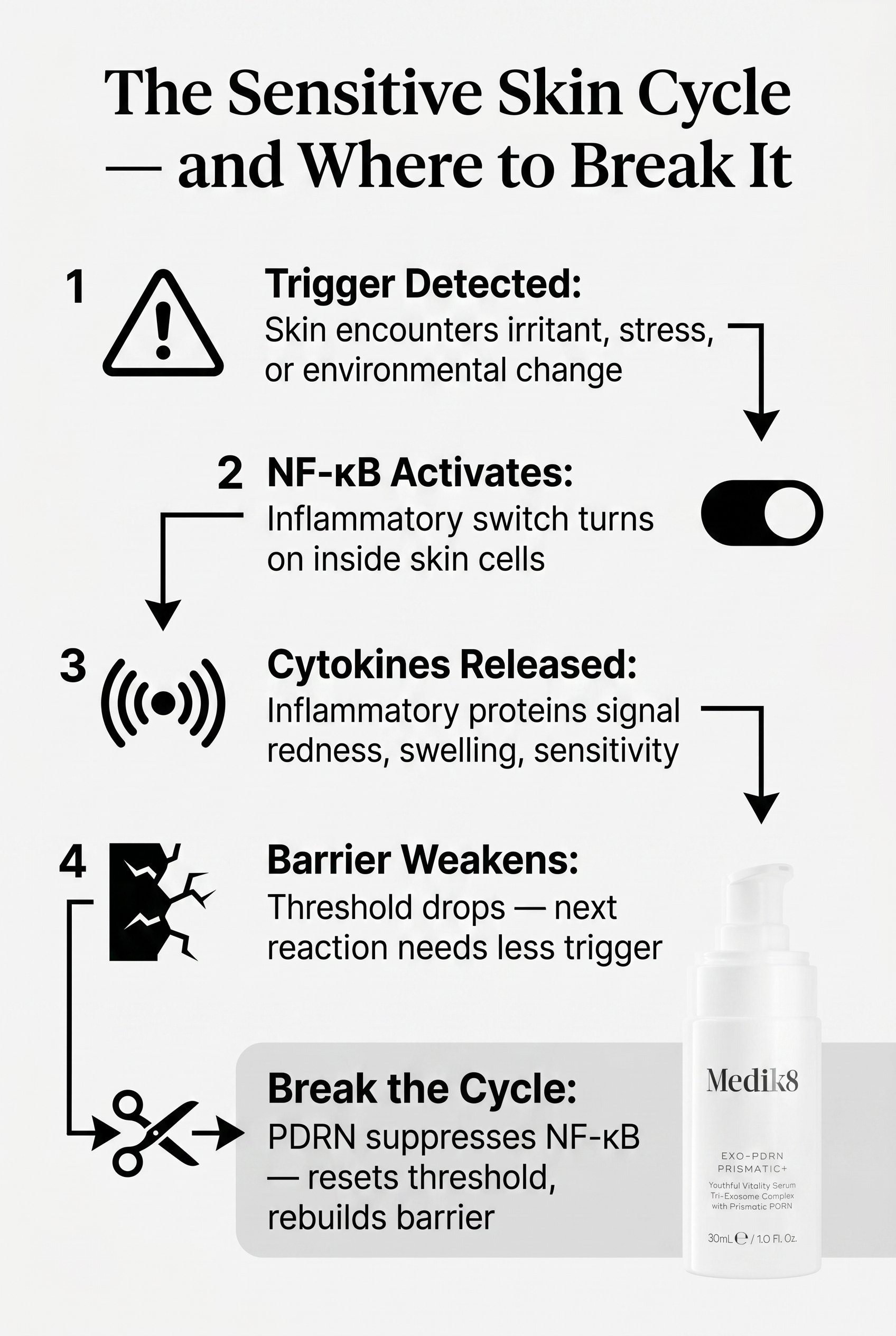
Here's what's actually happening beneath the surface. Your skin has an internal inflammatory switch called NF-κB (nuclear factor kappa B). Think of it as the alarm system inside your cells. When it's triggered, it tells your skin to mount a defence, redness, swelling, sensitivity. The problem is, for many people with reactive skin, that alarm won't turn off.
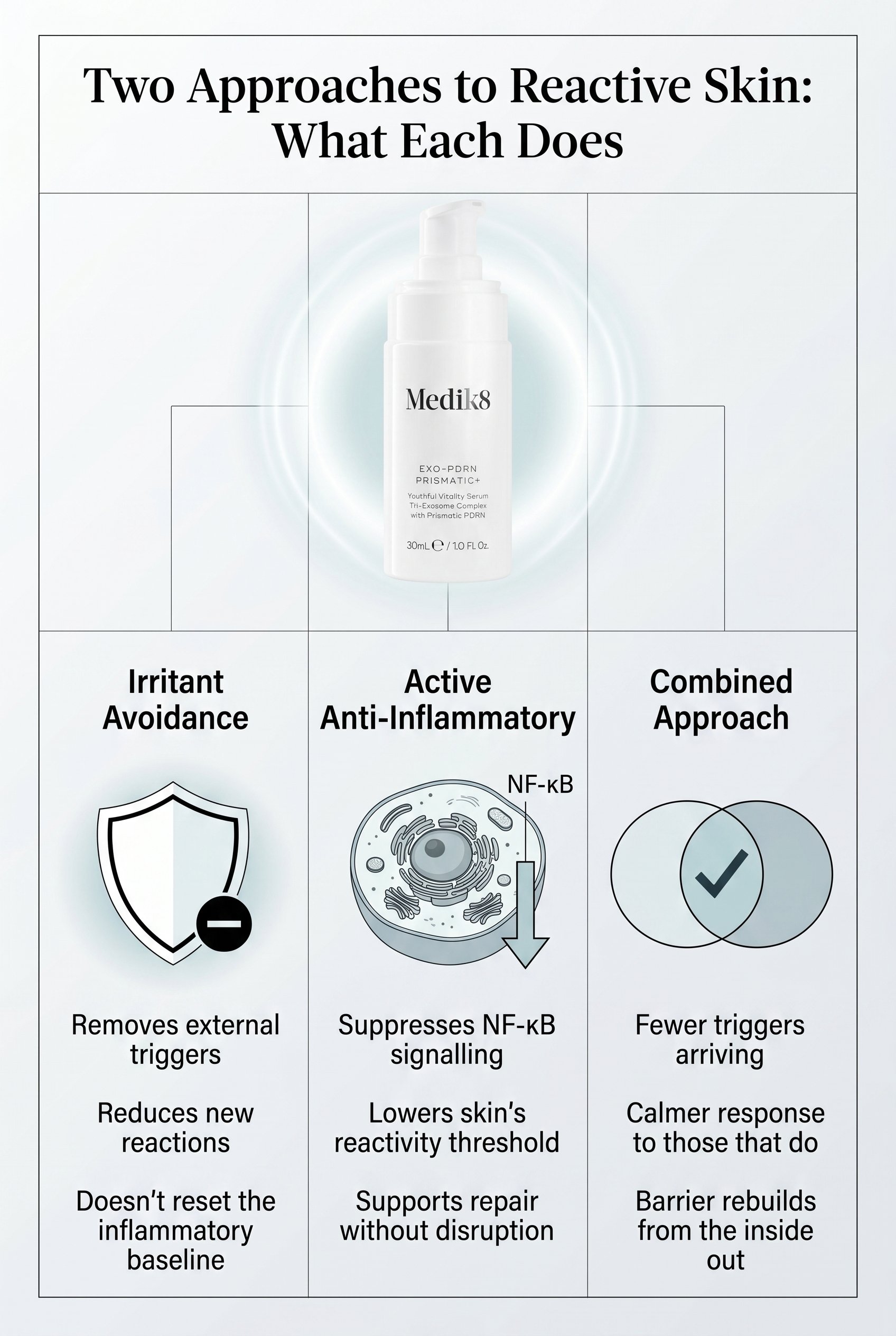
It stays on even when the original trigger is long gone. Avoiding irritants stops new triggers from arriving. But it doesn't reset the alarm that's already ringing. That's the gap active anti-inflammatory approaches are built to close.
Key Takeaways
- Irritant avoidance reduces triggers but doesn't stop the inflammatory cycle already running inside your skin.
- Active anti-inflammatory approaches target NF-κB, the protein that switches on your skin's inflammatory response.
- When NF-κB stays overactive, your skin stays reactive, even without a clear trigger.
- Ingredients like PDRN and exosomes suppress this pathway directly, helping skin regenerate without the damage phase that avoidance strategies can't address.
- For sensitive skin, combining b...
Why Irritant Avoidance Is a Good Start, But Not the Whole Strategy
Identifying and removing your personal triggers is genuinely useful. Fragrance, sulfates, high-pH cleansers, and certain preservatives cause real reactions in reactive skin. Cutting them out reduces the load on a skin barrier that's already working hard. If you haven't mapped your triggers yet, that's worth doing, and understanding which active ingredients suit your skin is part of that same process.
But avoidance is a passive strategy. It works by reducing inputs. It doesn't change how your skin processes those inputs. If your inflammatory response is already overactive, your skin will keep reacting, to stress, to temperature changes, to products that most people tolerate easily. You're managing the environment around a system that's still misfiring.
Think of it this way. If a smoke alarm keeps going off in an empty room, you can remove every candle in the house. That helps.
But the alarm is still faulty. Avoidance removes the candles. Active anti-inflammatory approaches fix the alarm.
What Is NF-κB and Why Does It Matter for Sensitive Skin?
NF-κB is a protein complex found in almost every cell in your body. In skin, it acts as a master switch for inflammation. When your barrier is breached, or your skin detects a threat, NF-κB activates.
It triggers the release of inflammatory signals called cytokines (proteins that tell nearby cells to respond). This is your skin doing its job. The problem starts when this response doesn't wind down.
In chronically reactive skin, NF-κB can become stuck in an active state. Researchers call this persistent low-grade inflammation. Your skin isn't in full crisis mode, but it's never fully calm either.
The threshold for a visible reaction drops. Products that were once fine start causing issues. Your skin feels unpredictable because, at a cellular level, it's primed to react.
This is why some people find their sensitivity gets worse over time, even when they're being careful. Each reaction lowers the threshold a little more. Stress compounds this, cortisol directly activates NF-κB, which is why your skin often flares during difficult periods regardless of what you're putting on it.
Active Anti-Inflammatory: What It Actually Means
Active anti-inflammatory skincare doesn't just soothe the surface. It works at the cellular level to interrupt the signalling chain that keeps inflammation running. The goal is to suppress NF-κB activity directly, reducing the production of inflammatory cytokines before they cause visible damage to your barrier.
This is a different category of action from ingredients like oat extract or aloe vera, which calm the skin's surface. Those are useful. But they're downstream of the problem. Active suppression targets the source.
PDRN (polydeoxyribonucleotide) is one of the most studied ingredients in this space. PDRN is a chain of DNA fragments derived from salmon sperm cells. It binds to adenosine receptors on the surface of your skin cells. This binding has two effects.
First, it activates tissue repair pathways. Second, it actively suppresses NF-κB signalling. The result is less inflammatory output and faster regeneration, at the same time. Clinical research shows PDRN reduces pro-inflammatory cytokines including TNF-α and IL-6, two key drivers of chronic skin reactivity.
Exosomes (tiny messenger particles released by stem cells) work alongside PDRN by delivering growth factors and regulatory signals directly into skin cells. Together, they don't just quiet the reaction, they give skin the tools to rebuild what inflammation has damaged.
Regeneration Without the Damage Phase: What This Looks Like in Practice
Most people think of skin regeneration as something that involves a difficult period first. Retinoids cause peeling. Acids cause purging.
Even beneficial treatments often come with a disruption phase that reactive skin struggles to tolerate. This creates a real problem. Sensitive skin often needs the most support but can handle the least disruption.
The case for PDRN and exosome technology is that it offers a different path. Regeneration happens through repair signalling rather than controlled damage. Cell proliferation (the process of new cells forming) increases by over 50% in ex vivo studies (tests done on skin tissue outside the body).
Barrier function improves. Inflammatory output drops. And this happens without triggering the initial damage response that makes other actives hard to tolerate.
In post-procedure validation, 98% of participants agreed the approach supported skin health during the recovery phase. This is meaningful for reactive skin outside of clinical settings too. If your barrier is already compromised, from over-exfoliation, environmental stress, or a sensitivity spiral, you need regeneration that works with your skin's current state, not against it. You can read more about how over-exfoliation compromises your barrier and why repair comes before reintroducing actives.

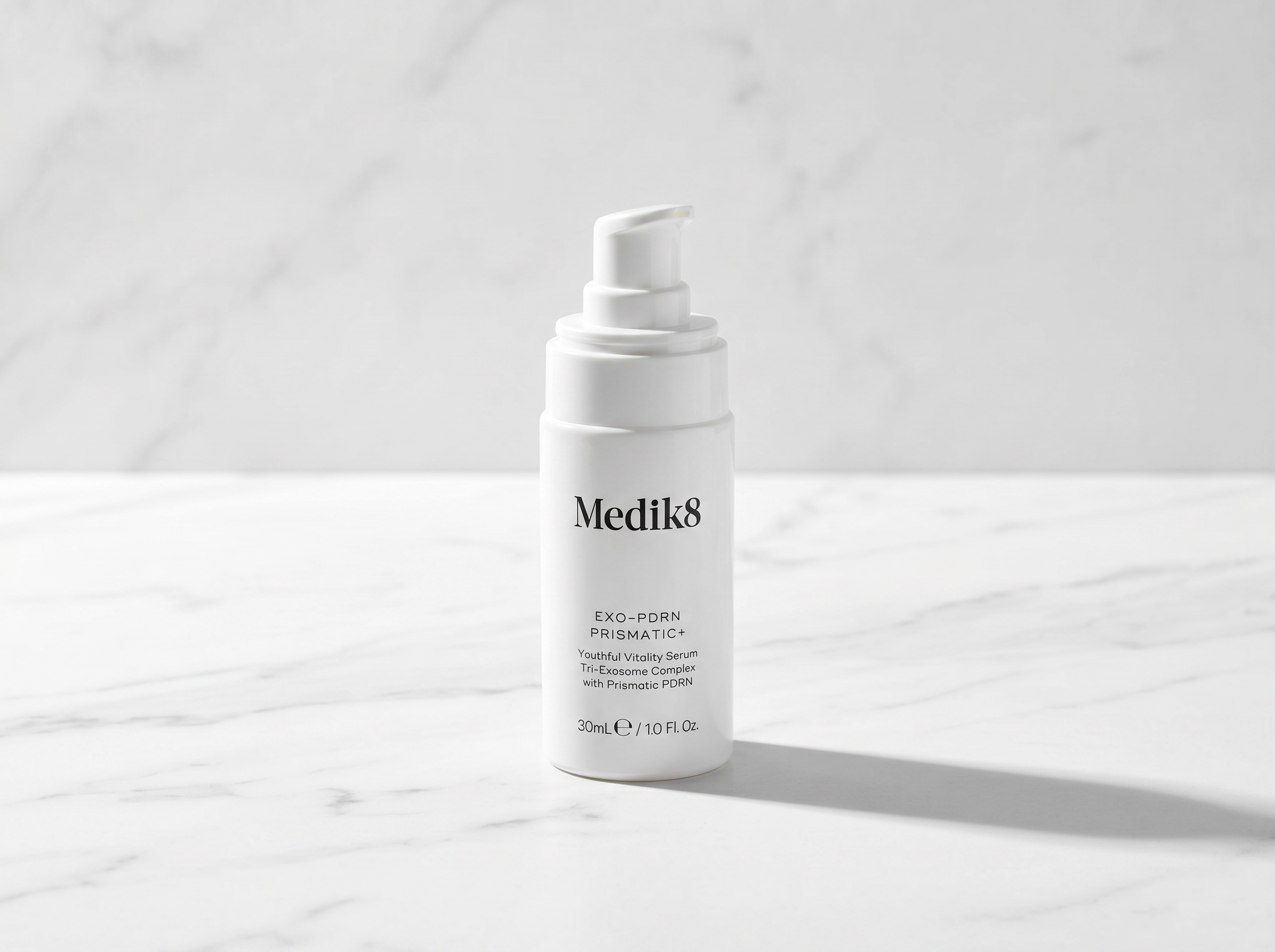
Featured: Exo-PDRN Prismatic+
A full-spectrum face serum that boosts skin's natural rejuvenation by over 50%.
Shop NowHow to Combine Both Approaches for Reactive Skin
Avoidance and active anti-inflammatory work are not competing strategies. They work best together. Avoidance reduces the triggers that keep activating your inflammatory response.
Active suppression addresses the underlying state that makes your skin reactive in the first place. One manages your environment. The other changes how your skin responds to it.
A practical approach looks like this. First, identify and remove your confirmed triggers. Fragrance and sulfates are the most common culprits, but your specific profile matters more than the general list. Second, support your barrier with ingredients that help your skin synthesise its own ceramides (the natural fats that hold your barrier together) rather than just applying ceramides from outside. Third, introduce active anti-inflammatory support that targets NF-κB directly, giving your skin a path to calm that doesn't depend on perfect environmental control.
The goal is a skin state where your threshold is high enough that minor exposures don't cause major reactions. That's not achievable through avoidance alone. It requires changing the baseline.
Is Active Anti-Inflammatory Right for Your Skin Right Now?
This approach suits skin that is reactive but not severely compromised. If your barrier is in acute crisis, raw, broken, or actively inflamed, the priority is barrier repair first. Once your skin has a stable foundation, active anti-inflammatory support becomes the next logical step. Understanding whether your skin is dry or dehydrated can help you assess your barrier's current state before adding new actives.
This approach is also well suited to skin that has plateaued on avoidance strategies. If you've removed all the obvious triggers and your skin is still reactive, the problem is likely internal rather than environmental. That's exactly the gap active NF-κB suppression is designed to address.
this is not a replacement for acne treatment, and it's not suited to severely compromised barriers or known nucleotide sensitivities. If you're unsure where your skin sits, booking a skin consultation with Skinmart gives you a personalised read on your skin's current state before you make any changes.
Irritant avoidance is smart skincare. Knowing your triggers and removing them reduces the load on a skin barrier that's already working hard. But if your skin stays reactive despite careful product choices, the issue isn't what you're putting on it, it's the inflammatory state running underneath. That's the part avoidance can't reach.
Active anti-inflammatory approaches like PDRN and exosome technology target NF-κB directly. They help your skin stop reacting before the reaction starts. And rebuild what chronic inflammation has worn down, without requiring a damage phase to get there. If you're ready to move beyond avoidance and into active repair, shop Exo-PDRN Prismatic+ or book a skin consultation to find the right approach for where your skin is right now.


