
Your acne cleared. But the marks stayed. Sound familiar?
Most acne content focuses on stopping breakouts. That makes sense, but it misses half the story. The breakout itself is only one part of what happens to your skin. What comes after, the healing phase, is where scarring is decided. And for most people, that phase gets almost no attention at all.
This post is about that second phase. We look at why some acne heals without a trace while other lesions leave marks that last months or years. We look at what drives that difference. And we look at what you can actually do about it, not to treat active acne. But to support your skin through recovery so it heals as cleanly as possible.
Why Does Acne Leave Marks at All?
When a pimple forms, your immune system responds fast. It sends inflammatory signals to the area to fight bacteria and clear debris. This is normal and necessary. But inflammation is also damaging if it goes on too long or too hard.
Think of it like road works. A short, controlled repair job leaves the road smooth. But if the crews dig too deep, work too long, or leave the site exposed, the road surface ends up uneven.
Your skin works the same way. A well-managed inflammatory response clears the lesion and rebuilds tissue cleanly. An overactive or prolonged response damages the collagen beneath the surface, and that damage shows up as a scar.
The marks you see after a breakout are not all the same. Understanding the difference matters for how you respond to them. Learn more about how acne markings form and how they're treated.
PIE, PIH, and Atrophic Scars: What Are You Actually Seeing?
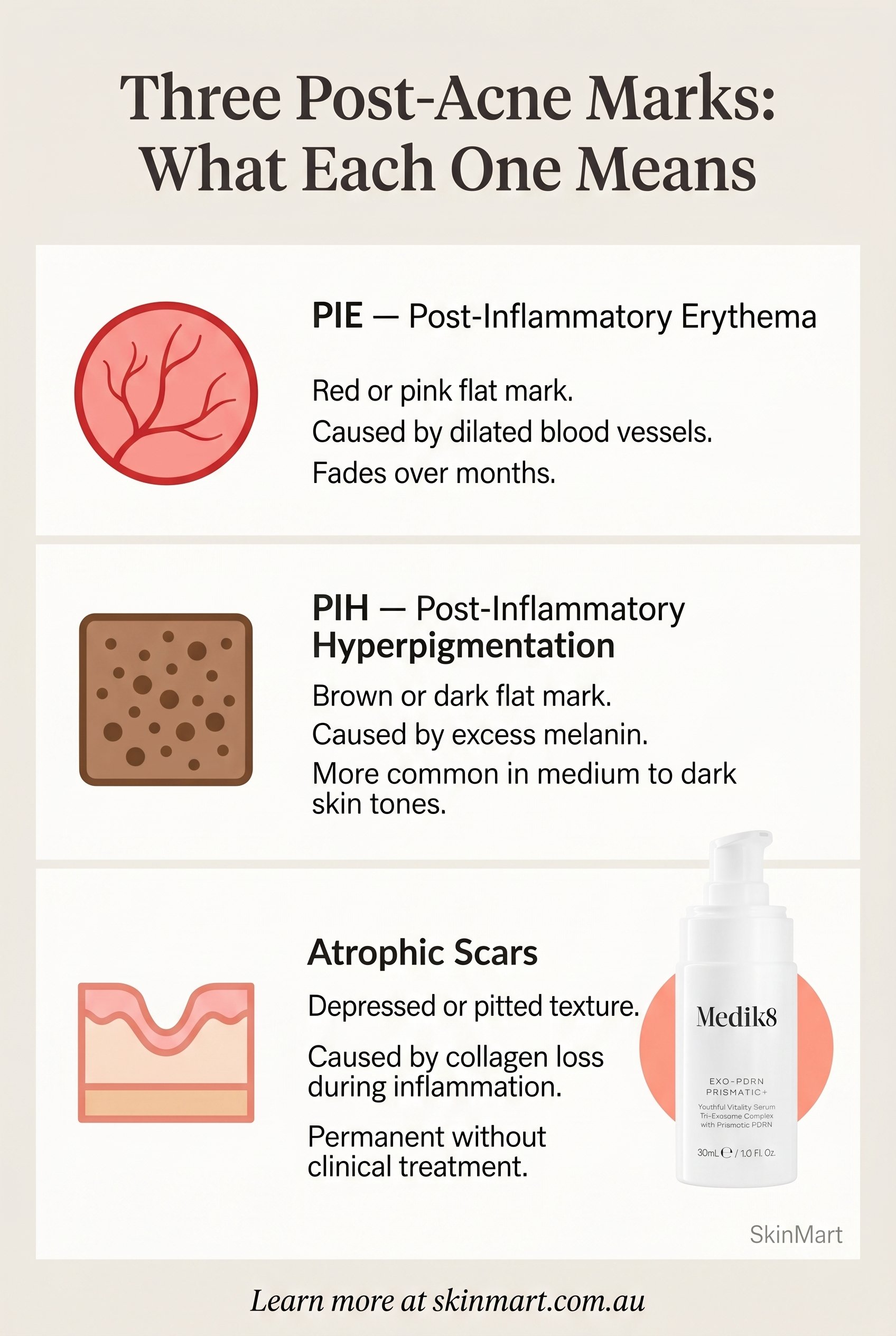
Post-inflammatory erythema, or PIE, is the red or pink flat mark left after a pimple heals. It happens when small blood vessels near the surface stay dilated after inflammation. PIE is not a true scar, it is a vascular response. It fades over time, but it can take months without support.
Post-inflammatory hyperpigmentation, or PIH, is the brown or dark mark that forms when inflammation triggers excess melanin production. Melanin is the pigment that gives skin its colour. When skin is inflamed, melanocytes (the cells that make melanin) can go into overdrive. The result is a flat dark spot where the pimple was. PIH is more common in medium to dark skin tones and can persist for six to twelve months or longer.
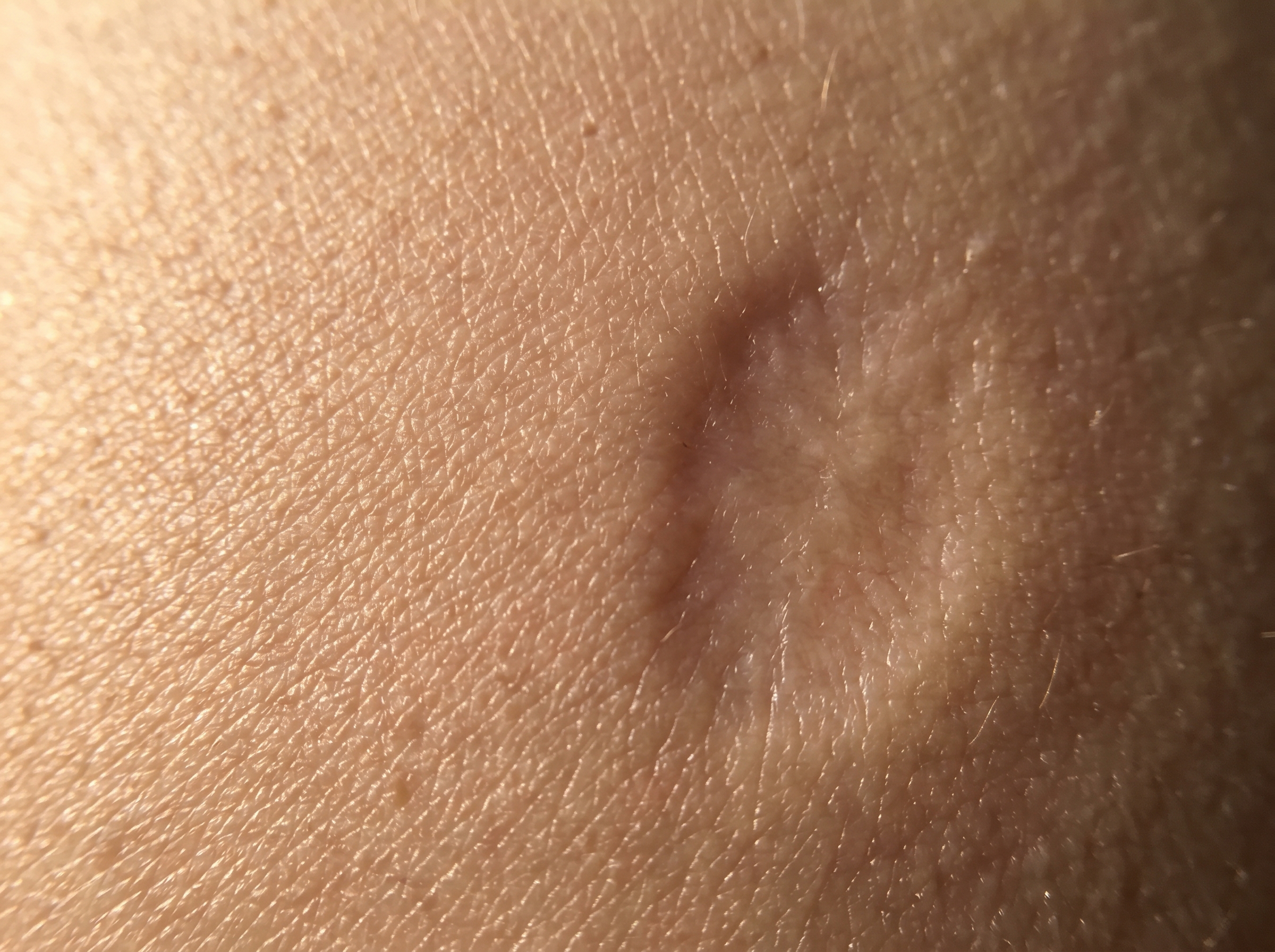
Atrophic scars are different again. These are the depressed or pitted marks, icepick, boxcar, and rolling scars, that form when inflammation destroys collagen in the deeper layers of skin. Once collagen is lost, the skin surface sinks inward. This type of scarring is permanent without clinical intervention. It is also the most preventable, because it forms during the active inflammatory phase, before the lesion has fully healed.
The common thread across all three? Inflammation duration and intensity. The longer and harder your skin stays inflamed, the higher the risk of lasting damage. Read more about how pigmentation forms and what helps fade it.
Key Takeaways
- Acne lesions heal on their own, but scarring depends on what happens during recovery.
- When inflammation runs too long or too hard, it damages the collagen and tissue beneath the skin.
- This can leave behind red or brown marks (post-inflammatory erythema or hyperpigmentation) or textural scars.
- The key is supporting your skin's repair process while inflammation is still active.
- Targeted recovery support, not just acne treatment, is what determines whether your skin heals cleanly or leaves a las...
Why Your Post-Inflammatory Response Determines Scarring Risk
Here is something most acne content skips over: the breakout itself does not cause the scar. The scar forms during recovery. Specifically, it forms when the inflammatory response that was meant to heal the lesion overshoots its target.
When inflammation resolves quickly and cleanly, fibroblasts (the cells that produce collagen) rebuild the tissue in an organised way. The skin surface returns to normal. But when inflammation lingers, those same fibroblasts are working in a damaged, cytokine-rich environment.
Cytokines are chemical signals your immune system releases during inflammation. In high amounts, over a long period, they disrupt normal collagen production. The result is disorganised repair, and that is what a scar is.
This is why two people with the same type of acne can have very different outcomes. Genetics play a role. Skin tone plays a role. But so does how well the skin's repair process is supported during recovery. That is the part you can influence.
It also explains why treating active acne and supporting post-acne recovery are two separate jobs. Clearing the breakout is one task. Giving your skin what it needs to rebuild cleanly is another. Most routines only address the first.
What Does Recovery-Focused Skin Support Actually Look Like?
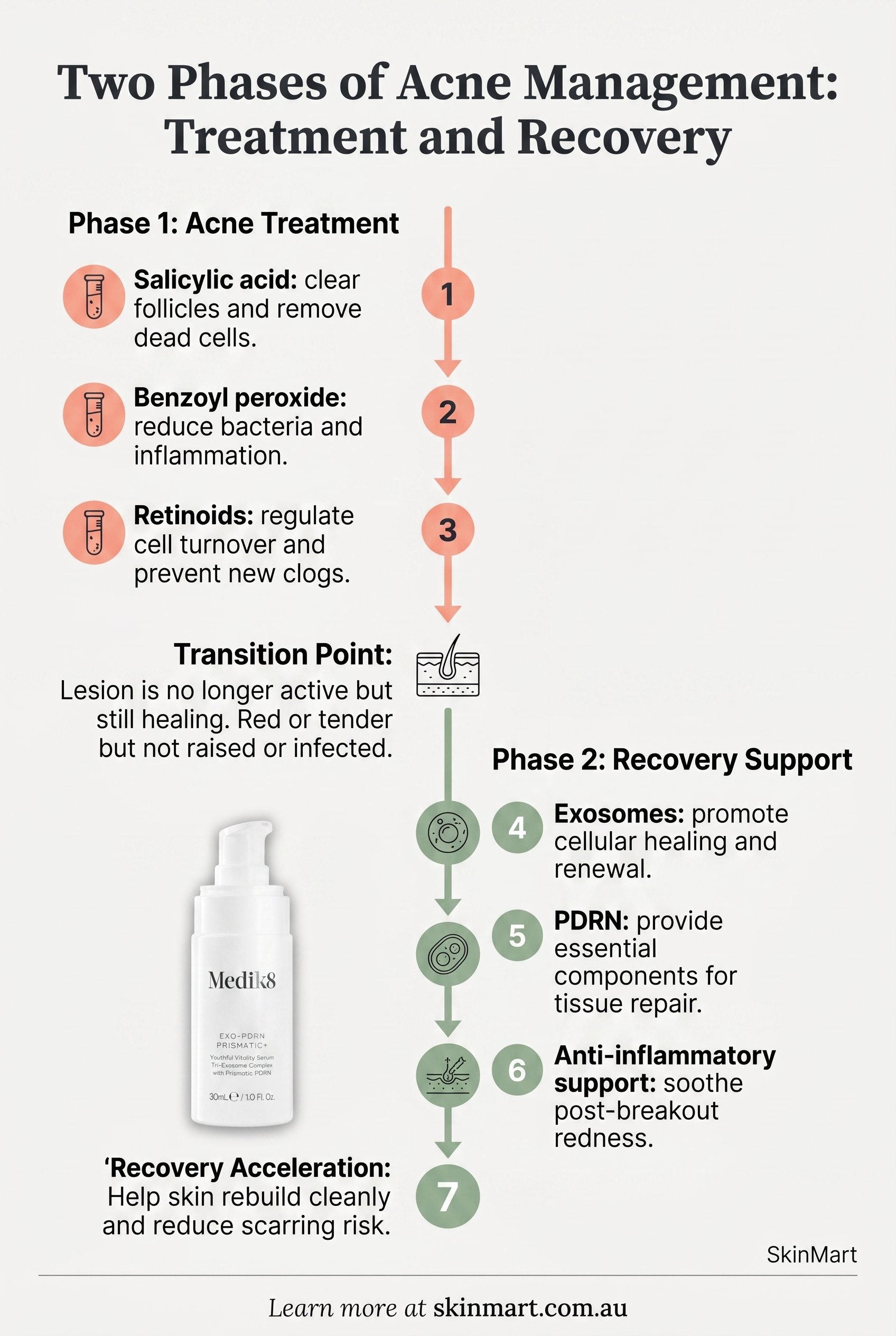
Recovery support is not the same as acne treatment. Salicylic acid, benzoyl peroxide, and retinoids are excellent for managing active acne. They clear follicles, reduce bacteria, and regulate cell turnover. But they are not designed to support tissue repair in healing skin. Some can even slow recovery if used too aggressively during the healing phase.
What healing skin actually needs is different. It needs anti-inflammatory support to help calm the residual immune response. It needs signals that encourage organised collagen production. And it needs barrier support so the skin surface can recover without added stress.
This is where regenerative ingredients become relevant. Ingredients that work at the cellular level, supporting the skin's own repair systems rather than treating the surface, can make a real difference to how cleanly a lesion heals. The goal is not to speed up healing at the expense of quality. It is to give your skin the right environment to do the job it is already trying to do.
If you are also working through an active acne routine, it is worth reading about what to look for in your skincare products when managing breakouts. Getting the treatment phase right makes the recovery phase easier.

Featured: Exo-PDRN Prismatic+
A full-spectrum face serum that boosts skin's natural rejuvenation by over 50%.
Shop NowHow Exo-PDRN Prismatic+ Supports Post-Acne Healing
Product spotlight: Exo-PDRN Prismatic+ by Medik8
Exo-PDRN Prismatic+ is a full-spectrum regenerative serum built around two key ingredient technologies: a Triple Exosome Complex and Prismatic PDRN (polydeoxyribonucleotide, or PDRN for short).
Exosomes are tiny messenger particles your cells naturally use to communicate. In skincare, lab-derived exosomes carry growth factors and regenerative signals directly into the skin. They help coordinate the repair process at a cellular level.
PDRN is a DNA fragment derived from salmon sperm cells. It has been studied in clinical settings for wound healing and tissue repair. In skin, PDRN supports cell proliferation (the process of new cells forming) and helps restore the energy your cells need to do repair work.
Together, these two technologies target the post-inflammatory phase directly. They are not designed to treat active acne. They are designed to support what comes after, helping your skin rebuild more efficiently and with less residual damage. Clinical data on this formulation shows over 50% improvement in cell proliferation in ex vivo studies, with measurable improvements in skin health, luminosity, and barrier function within seven days. It has also been validated for post-procedure use, with 98% of participants agreeing it supported skin recovery without disruption.
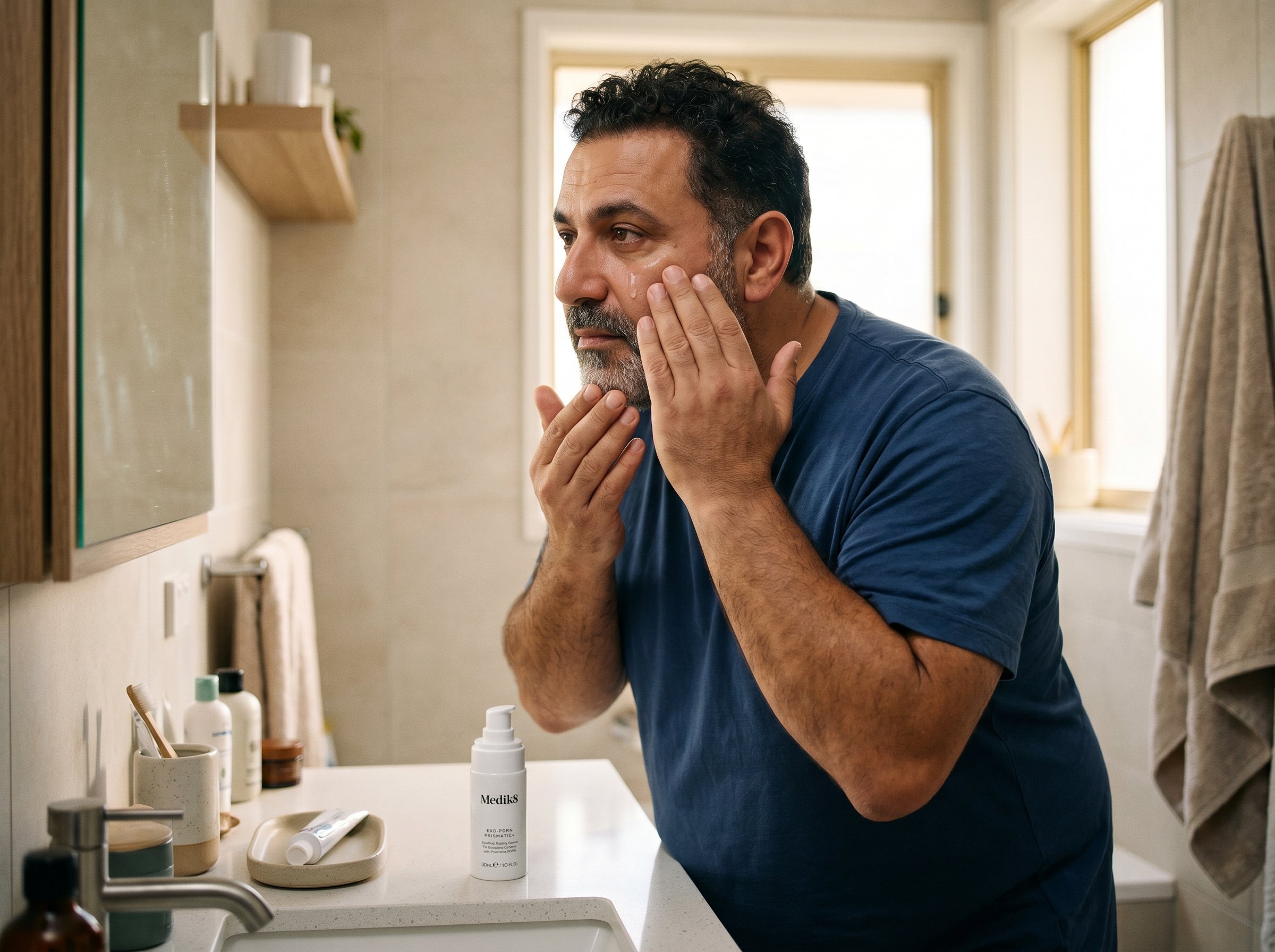
For skin recovering from acne, this matters. The product does not interfere with your acne treatment routine. It works alongside it, addressing the recovery phase that most routines leave unsupported. Shop Exo-PDRN Prismatic+ now.
When Should You Add Recovery Support to Your Routine?
The best time to start supporting recovery is while inflammation is still active, not after you can already see a scar forming. This is because the window for influencing collagen quality is during the repair phase, not after it has finished.
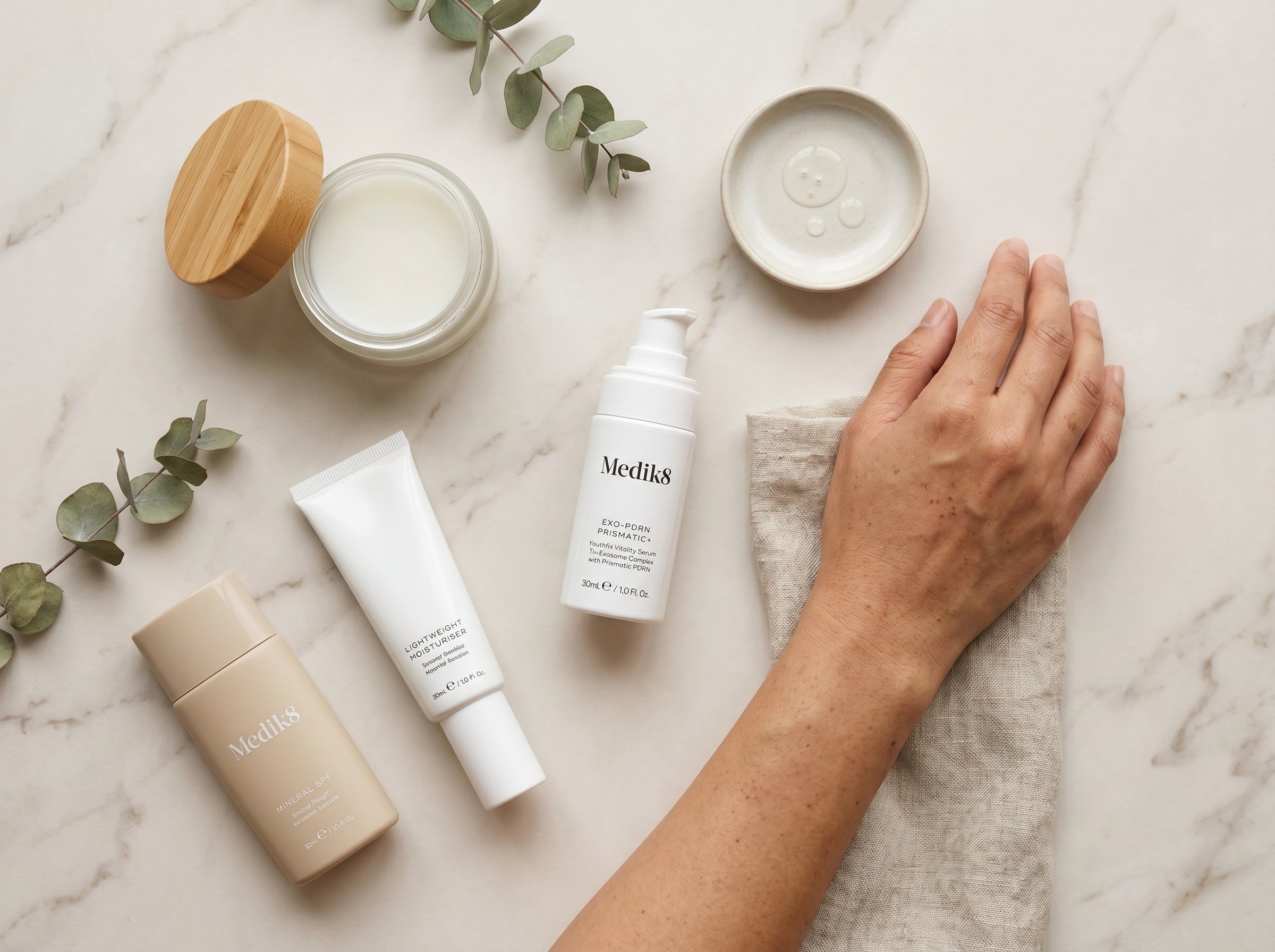
If you have a healing lesion that is no longer raised or actively infected but still red or tender, that is the recovery phase. That is when regenerative support is most useful. Adding it too early, while a lesion is still active, is not appropriate. But waiting until you can see a mark has already formed means you have missed the most effective window.
In practical terms, this means having recovery support ready as part of your routine, not as a reactive step you reach for when things go wrong. Think of it as the second half of your acne management plan. The first half clears the breakout. The second half supports the skin as it heals.
If you are curious about how your diet might be affecting your skin's inflammatory load. This can influence both breakout frequency and healing speed, this article on diet and breakouts is worth reading.
Acne heals. That part is true. But whether it heals cleanly, without marks, without texture changes, without months of fading ahead of you, depends on what happens during recovery. The post-inflammatory phase is where scarring is decided. And it is the phase most routines completely ignore.
Understanding the difference between PIE, PIH, and atrophic scarring gives you something useful: clarity about what you are dealing with and what kind of support actually helps. Treating active acne and supporting post-acne recovery are two separate jobs. Doing both, in the right order, is what gives your skin the best chance of healing without a trace.
If you are ready to add recovery support to your routine, explore Exo-PDRN Prismatic+ and see how it fits alongside what you are already doing. Or book your skin consultation to get a full picture of what your skin needs, not just for clearing breakouts, but for healing well after them.


