
You already run a full routine. A cleanser, a serum, a moisturiser, and SPF every single day. So when you spot an antioxidant serum with eight antioxidants and a peptide, it's fair to ask a simple question. Does this replace my vitamin C, or sit alongside it?
Short answer: it sits alongside it. But the reason why is worth understanding, because it explains what your skin is actually dealing with each day. And where a broader antioxidant serum picks up what a single ingredient cannot cover on its own.
What Does a Day Actually Do to Your Skin?
Every day, your skin meets sun, pollution and everyday stress, whether you notice it or not. None of this is dramatic on its own. But it adds up quietly, layer by layer, over weeks and months.
Over time, that quiet wear can show up as dullness, an uneven-looking tone, or skin that feels less firm than it used to. This is not a sign your routine has failed you. It is simply what a day does to skin, for everyone.
This is also why daily sun protection matters all year round in Australia, not only in summer. An antioxidant serum works alongside SPF. It does not replace it.
Why Would One Antioxidant Serum Not Cover Everything?
A single antioxidant, like vitamin C, is genuinely useful. It supports skin against daily stress and helps skin look brighter over time. But one antioxidant tends to work at one particular point in that process.
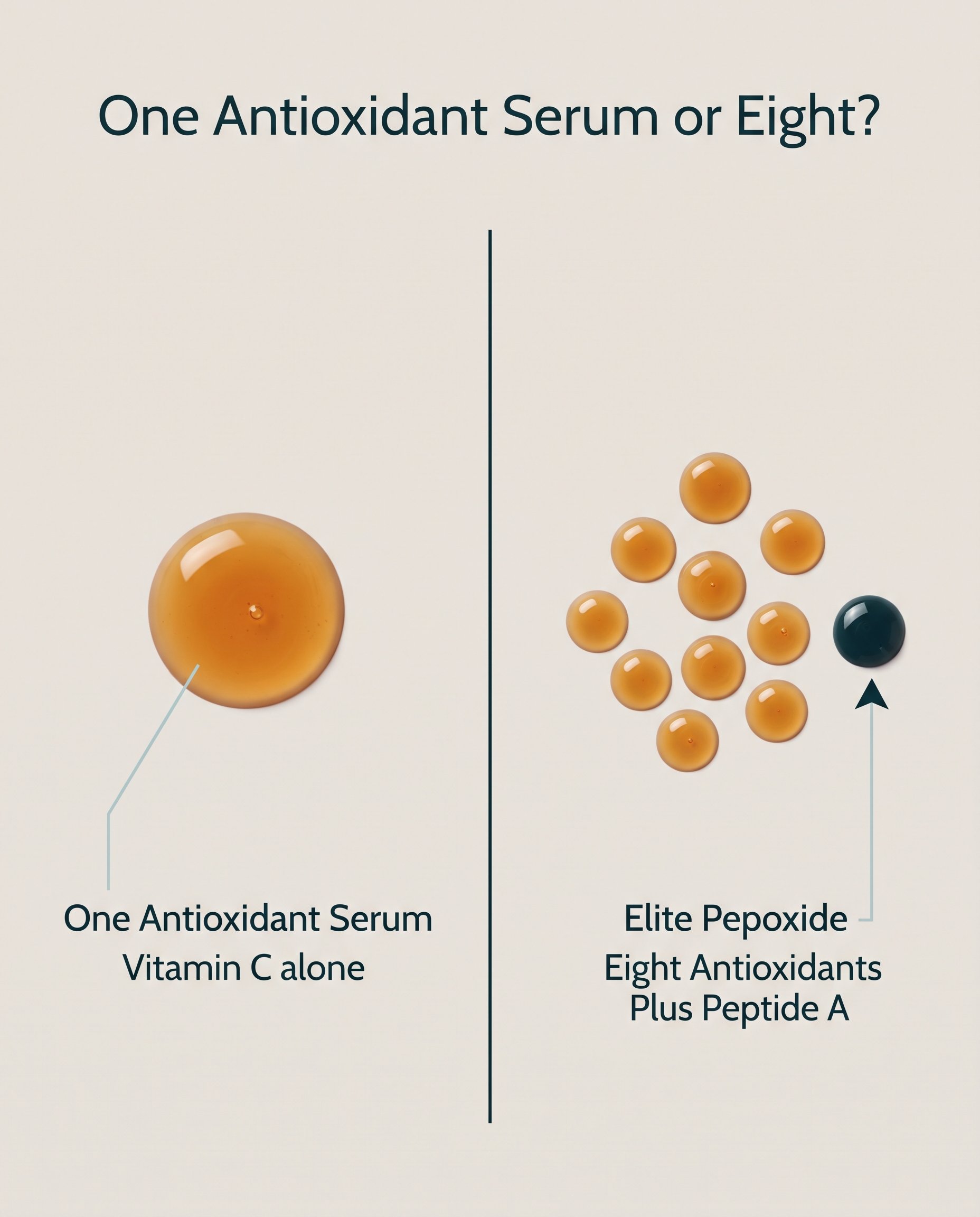
Different antioxidants step in at different points across the day. Astaxanthin, ferulic acid, superoxide dismutase, glutathione, quercetin, caffeine and gluconolactone each play a slightly different role. Put several together in one antioxidant serum, and you are covering more ground in a single layer.
This is the idea behind formulas like Cosmedix Elite Pepoxide, which carries eight antioxidants in one water-light serum that sinks in within seconds. It's not about one ingredient doing everything. It's about several working together.
Key Takeaways
- An antioxidant serum with several antioxidants covers more of the day's stress on skin than a single ingredient like vitamin C alone.
- Each antioxidant works at a slightly different point, so combining a few in one layer, such as astaxanthin, ferulic acid, superoxide dismutase, glutathione, quercetin, caffeine and gluconolactone, gives broader daily support.
- Adding a peptide, like Acetyl Hexapeptide-1, brings a skin-conditioning ingredient linked to how skin responds to stress, though evidence...
What Does a Peptide Add to the Mix?
Alongside its eight antioxidants, Elite Pepoxide also carries a peptide called Acetyl Hexapeptide-1. Peptides are small chains of amino acids, the building blocks your skin already uses to function day to day.
Acetyl Hexapeptide-1 is a skin-conditioning peptide. Early research suggests it plays a role in how skin responds to everyday stress. This is still an emerging area of study, so we see it as one supportive piece of a broader formula, not a stand-alone result.
Paired with antioxidants, this peptide adds a second layer of support that vitamin C alone does not carry.
When and How Do You Use It?
Apply your antioxidant and peptide serum after cleansing and before moisturiser, on clean, dry skin. Evening is the ideal time, since this is when skin focuses on repair and renewal overnight.
If you prefer using it in the morning, always follow with SPF. Start once a day and build up to twice daily as your skin adjusts. If you have sensitive skin, begin with evening use every other day for two weeks before increasing.
Avoid layering it with other exfoliating acids or a retinoid in the same application. Give each active its own moment, and your skin its own time to adjust between them. For more on the order actives should go in, see our guide on using your products in the right order.
Does This Replace Your Vitamin C Serum?
No. An antioxidant and peptide serum supplements vitamin C, it does not replace it. Vitamin C remains a strong, well-studied antioxidant, and it can complement a wider antioxidant network rather than compete with it.
When you introduce a new active, add one at a time. This makes it easier to see how your skin responds. A simple, workable split is vitamin C in the morning and your antioxidant and peptide serum at night.
If you want a refresher on why vitamin C earned its place in so many routines, our piece on why you need vitamin C in your skincare routine is a good place to start.
What Can You Expect, and When?
Give it weeks, not days. Most people notice smoother-feeling texture first, usually within a few weeks of consistent use.
Tone tends to look more even with continued use, and many describe skin as looking firmer over time. Think of this as the firmness you have, kept, and supported for longer, rather than a dramatic overnight change.
Consistency matters more than intensity here. A serum used most nights for a few months will do more than one used occasionally for a week.
You do not need to choose between vitamin C and an antioxidant and peptide serum. They are built to work alongside each other, each covering a different part of what your skin deals with daily.
If you are curious about where an antioxidant serum like Elite Pepoxide might fit into your current routine, our team is always happy to talk it through with you. Learn more about how active ingredients fit your routine before adding anything new.


