
A glycolic acid peel at home sounds simple until you're standing in front of ten different bottles, wondering which one won't leave your skin red and angry. You've read the reviews. You've seen the glow-up photos. But nobody's told you which percentage is right for your skin, or when a DIY peel stops being a treat and starts being a risk.
This guide breaks the science down in plain terms. We'll walk through the percentage ladder, how to build tolerance safely, and which products (like Alpha-H Liquid Gold, Medik8 Press & Glow, and the Mesoestetic glycolic range) suit different experience levels. We'll also tell you honestly when an at-home peel isn't enough, and a professional treatment is the smarter choice.
What Is a Glycolic Acid Peel, and Why Can You Do One at Home?
Glycolic acid is an alpha hydroxy acid (AHA) made from sugar cane. It has the smallest molecule size of any AHA, which lets it slip past your skin's outer layer with ease. Once inside, it loosens the desmosomes, the tiny bonds holding dead skin cells together, so they shed faster.
This is why glycolic acid peels are prized for improving texture, dullness, and mild pigmentation. Research on AHA exfoliation consistently shows measurable improvement in skin smoothness and tone with regular, correct use over several weeks.
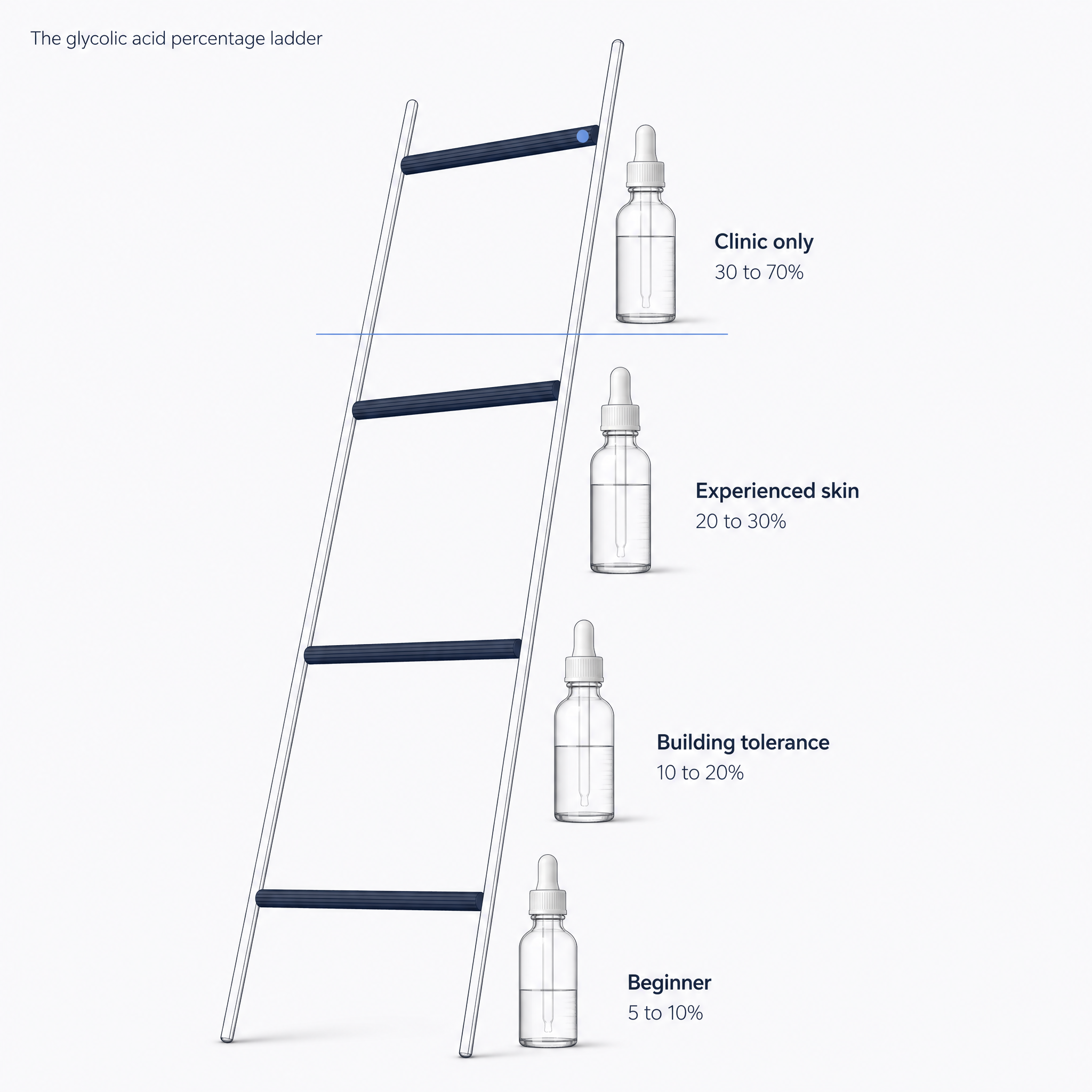
At-home peels use far lower concentrations than clinic treatments. Professional peels can reach 30 to 70% glycolic acid, applied by a trained therapist who controls the timing and neutralisation. At-home versions usually sit between 5% and 30%, formulated to be safer for unsupervised use. If you're still working out which exfoliation method suits your skin, our guide on choosing the right exfoliation for your skin type is a good place to start.
The Percentage Ladder: How to Build Glycolic Acid Tolerance Safely
Your skin needs time to adjust to acids, just like your legs need time to build up to a longer run. Jumping straight to a high percentage is the fastest way to end up with redness, stinging, and a damaged skin barrier.
Start low. Products with 5 to 10% glycolic acid are a safe entry point for anyone new to peels. Alpha-H Liquid Gold sits in this range, with 5% glycolic acid designed for overnight use. It's gentle enough for most skin types, though a patch test is still non-negotiable.
Once your skin tolerates that level without redness or flaking, you can move to 10 to 20% formulas. This is where a product like Medik8 Press & Glow sits, offering a stronger exfoliating action for skin already used to acids.
The 20 to 30% range is the top end of what's safe for home use, and it's really only for experienced skin. The Mesoestetic glycolic range includes options at this strength, but they're best introduced slowly and used sparingly. Anything above 30% belongs in a clinic. If your skin tends to be sensitive or rosacea-prone, you may find PHAs offer a gentler exfoliating option than glycolic acid. You can browse our full range of exfoliants to compare strengths side by side.
How to Use a Glycolic Acid Peel at Home Safely (Step-by-Step)
Getting the process right matters as much as choosing the correct percentage. Here's the basic method most at-home peels follow.
Patch test first. Apply a small amount behind your ear or on your inner arm, then wait 24 hours to check for a reaction. Cleanse and dry your skin before application, since damp skin lets acid penetrate too fast. Apply a thin, even layer and set a timer, following the exact contact time on the label.
Rinse or neutralise when the time is up, even if the label says to leave it on. Mild redness and tingling are normal, but burning or sharp stinging means you rinse immediately. Moisturise straight after to support your skin barrier, and always follow with SPF 50+ the next morning, since exfoliated skin burns more easily.
Start with one application a week. If your skin handles it well after two or three uses, you can move to twice a week. More isn't better. It just raises your risk of irritation and a damaged skin barrier. For more on getting frequency right, read our guide to common exfoliation mistakes.
Which At-Home Glycolic Acid Products Are Worth Trying?
Not every glycolic product suits every skin type or experience level. Here's how three well-regarded options compare.
Alpha-H Liquid Gold is a well-known overnight treatment with 5% glycolic acid. It's formulated for beginners and sensitive-leaning skin, making it a sensible first peel if you've never used acids before. Apply it on cotton pads a few nights a week, then build from there.
Medik8 Press & Glow is a dual-phase, at-home peel that combines glycolic acid with other exfoliating acids for a more noticeable result. It suits skin that already tolerates lower-strength AHAs and wants a step up in intensity, without visiting a clinic.
The Mesoestetic glycolic range offers a wider spread of strengths, from gentle maintenance formulas to higher-percentage options for experienced users. This range works well if you want to progress along the percentage ladder within one trusted line, rather than switching brands as your tolerance builds.
Whichever product you choose, the goal isn't the strongest peel you can find. It's the right peel for where your skin actually is right now. Learn more about how at-home peels fit into a full routine in our guide to at-home chemical peel benefits.
Key Takeaways
- A glycolic acid peel at home can smooth texture and boost glow, but only if you start low and build slowly.
- Begin with products under 10% glycolic acid, patch test first, and never combine peels with retinol or other acids on the same night.
- Alpha-H Liquid Gold (5% glycolic) is a gentle starting point, while Medik8 Press & Glow and the Mesoestetic glycolic ra...
When Should You See a Professional Instead of Peeling at Home?
At-home peels have limits, and knowing them is what keeps your skin safe. Some situations call for a therapist, not a bottle from your bathroom shelf.
See a professional if you have active acne, rosacea, or eczema, since exfoliating acids can make inflamed skin worse rather than better; in these cases, ingredients like azelaic acid are often better tolerated. The same applies if you're using prescription retinoids, isotretinoin, or have had recent laser or microneedling treatments. These combinations can seriously compromise your skin barrier.
Book a consultation if redness lasts longer than a day, if you notice burning, cracking, or persistent stinging, or if you've been peeling consistently for six to eight weeks with no visible improvement. These are signs your skin needs a different approach, not just a stronger product.
Darker skin tones (Fitzpatrick IV to VI) also carry a higher risk of post-inflammatory hyperpigmentation from acid use, so professional guidance on percentage and frequency matters even more. A trained therapist can properly assess your skin, something no product label can do.
Common Mistakes That Turn a Peel Into a Problem
Most at-home peel complications come down to a handful of avoidable mistakes.
Skipping the patch test. It takes 24 hours and can save you from a full-face reaction. Layering acids and retinol on the same night. This combination overwhelms your skin barrier and often causes more irritation than either ingredient alone. Going up in percentage too fast. Tolerance builds over weeks, not days, and supporting your barrier with ceramide-rich moisturisers helps prevent damage along the way.
Skipping sunscreen the next day. Freshly exfoliated skin is more vulnerable to UV damage and pigmentation, so SPF 50+ isn't optional. Peeling through a breakout or flare-up. Wait until your skin has calmed down before introducing any acid, even a gentle one.
A glycolic acid peel at home can genuinely improve texture and glow, but only when it's matched to where your skin actually is, not where you wish it was. Starting low, building slowly, and choosing the right product for your experience level makes the difference between a smoother complexion and an angry, reactive one.
If you're not sure which percentage or product fits your skin, that's a completely normal place to be. Our Skin Blueprint looks at your skin history, sensitivities, and goals before recommending anything, so you're never guessing your way through an acid ladder alone. Learn more about building a routine that's actually right for you.
Step-by-Step Guide
-
1
How to Use a Glycolic Acid Peel at Home Safely (Step-by-Step)
Getting the process right matters as much as choosing the correct percentage. Here's the basic method most at-home peels follow.
Patch test first. Apply a small amount behind your ear or on your inner arm, then wait 24 hours to check for a reaction. Cleanse and dry your skin before application, since damp skin lets acid penetrate too fast. Apply a thin, even layer and set a timer, following the exact contact time on the label.
Rinse or neutralise when the time is up, even if the label says to leave it on. Mild redness and tingling are normal, but burning or sharp stinging means you rinse immediately. Moisturise straight after to support your skin barrier, and always follow with SPF 50+ the next morning, since exfoliated skin burns more easily.
Start with one application a week. If your skin handles it well after two or three uses, you can move to twice a week. More isn't better. It just raises your risk of irritation and a damaged skin barrier. For more on getting frequency right, read our guide to common exfoliation mistakes.


