
Search "ceramides skincare" and you will find a lot of hype. But ceramides are not just a trend. They are natural fats that already live in your skin, holding your outer layer together like mortar between bricks.
If you deal with dry, flaky patches or skin that stings when you try new products, low ceramide levels could be part of the story. In this guide, we explain the science behind ceramides, why professional brands are so precise about the ratio they use, and what this means for your own routine.
What Are Ceramides, Really?
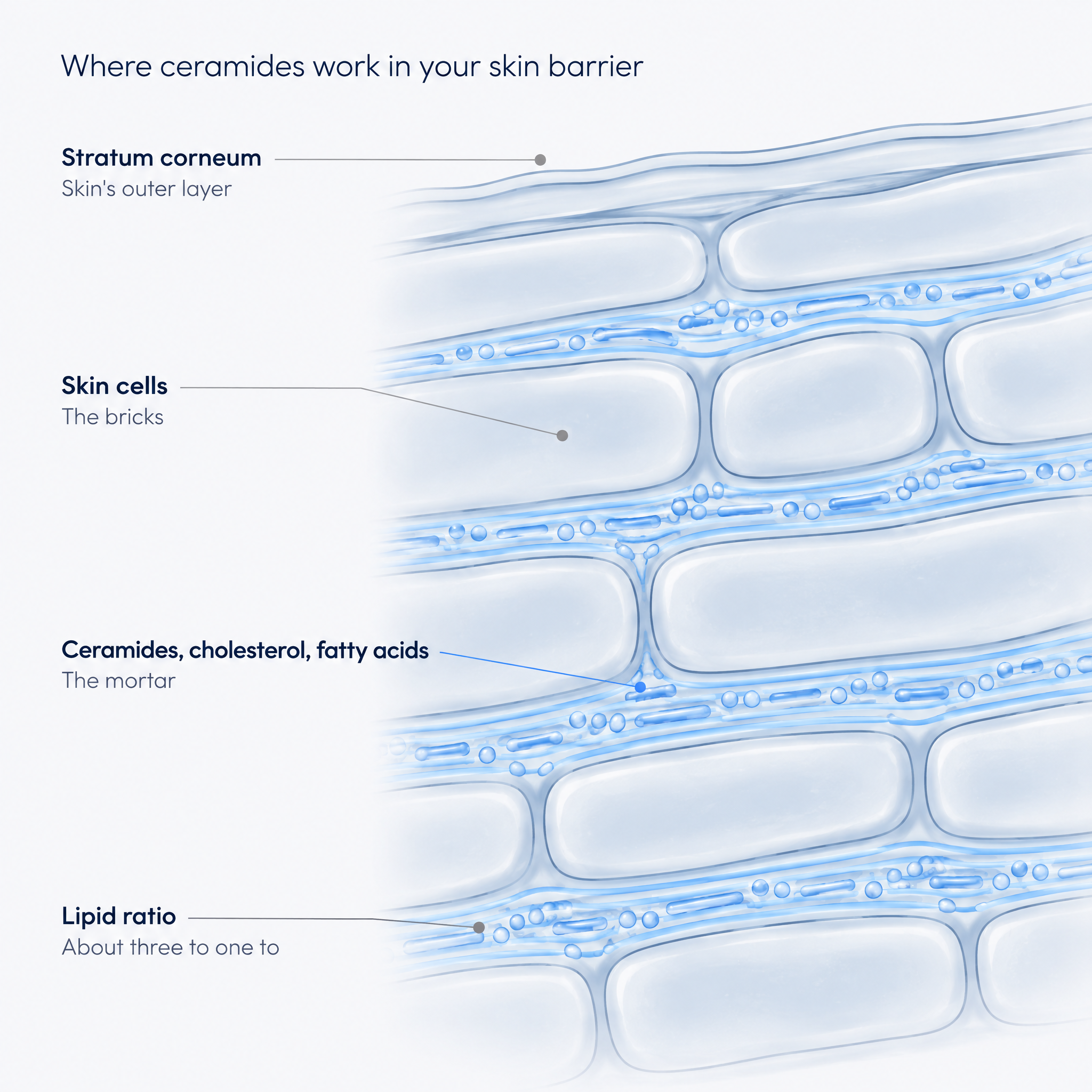
Ceramides are a type of fat, called a lipid, found naturally in your skin. They make up close to half the fats in your skin's outer layer, called the stratum corneum. Picture this layer as a brick wall. Your skin cells are the bricks. Ceramides, along with cholesterol and fatty acids, act as the mortar holding everything together.
Without enough mortar, that wall gets weak spots. Moisture escapes. Irritants get in more easily. This is why ceramide levels matter so much for skin that feels dry, tight, or reactive. Similarly, squalane, another lipid your skin already produces, helps reinforce this same protective layer.
Your body makes ceramides on its own. But this natural supply can drop with age, cold weather, harsh cleansers, and over-exfoliating. When levels fall, your barrier struggles to do its job.
Key Takeaways
- Ceramides are natural fats in your skin that hold skin cells together and lock in moisture.
- They sit in your skin's outer layer, called the stratum corneum, working alongside cholesterol and fatty acids to form your skin barrier.
- Research shows these three lipids work best in a specific ratio, often close to three parts ceramide to one part cholesterol to one part fatty acid.
- This is why professional skincare brands formulate with precise ratios, not just ceramides alone.
- When this balance is...
How Do Ceramides Protect Your Skin Barrier?
Your skin barrier has one main job. It keeps water in and everything else out. Scientists call water loss through the skin transepidermal water loss, or TEWL for short. A healthy barrier keeps TEWL low.
Ceramides help by forming organised layers inside the stratum corneum. These layers work like a shield. Studies show that skin with low ceramide levels loses more water and shows higher sensitivity (Coderch et al., 2003). This is one reason dermal therapists check barrier health before recommending an active ingredient, such as a gentle PHA exfoliant for sensitive skin types.
If you are unsure whether your skin issue is dryness or something deeper, our guide on dry versus dehydrated skin explains the difference and why it changes your approach.
Why Do Professional Brands Use a Specific Ceramide Ratio?
Here is where the science gets interesting. Ceramides do not work alone. Your skin barrier needs three types of lipids together: ceramides, cholesterol, and fatty acids.

Dermatology research found something worth knowing. Skin heals fastest when these three lipids sit in a certain balance, close to three parts ceramide to one part cholesterol to one part fatty acid (Man et al., 1996). Get this ratio wrong, and barrier repair can actually slow down. Too much of one lipid throws off the whole system.
This is why professional formulations are so deliberate. A product with ceramides high on the ingredient list is not automatically better. What matters more is whether the full lipid mix is balanced, often pairing ceramides with ingredients like niacinamide, another ingredient well known for supporting barrier function. This is a big part of what separates clinical-grade barrier repair creams from a basic moisturiser with a ceramide claim on the front.

Featured: Mesoestetic Age Element Anti-Wrinkle Concentrate
Bakuchiol stimulates collagen production and accelerates cell renewal with a retinol-comparable mechanism — without retinol's associated irritation.
Shop NowWhat Does This Mean for Sensitive and Dehydrated Skin?
If your skin reacts easily to new products, a weak barrier is often the reason why. A compromised barrier lets more irritants reach living skin cells underneath, which can trigger redness and stinging. For very reactive or blemish-prone skin, gentler ingredients like azelaic acid can be introduced once your barrier is stronger.
Dehydration works in a similar way. Dehydrated skin lacks water, not oil. But a ceramide-poor barrier makes it much harder for skin to hold onto any water you give it. Pairing a humectant like hyaluronic acid with a proper ceramide blend gives you both the water and the seal to keep it there. Our article on hyaluronic acid covers this hydration side in more depth.
Supporting your barrier is one of the most useful steps you can take, whether sensitivity, dehydration, or both are your main concern. Ingredients like centella asiatica (cica) are often paired with ceramides in recovery-focused formulas for extra calming support.
How Do I Choose Ceramide Products Across Different Brands?
You do not need to stick to one brand to build good barrier support. Many professional ranges include ceramide-rich formulas built around this lipid balance, not just a single ingredient on a label. If you also use a vitamin C serum, layering it with a ceramide moisturiser can help offset any dryness from active ingredients.
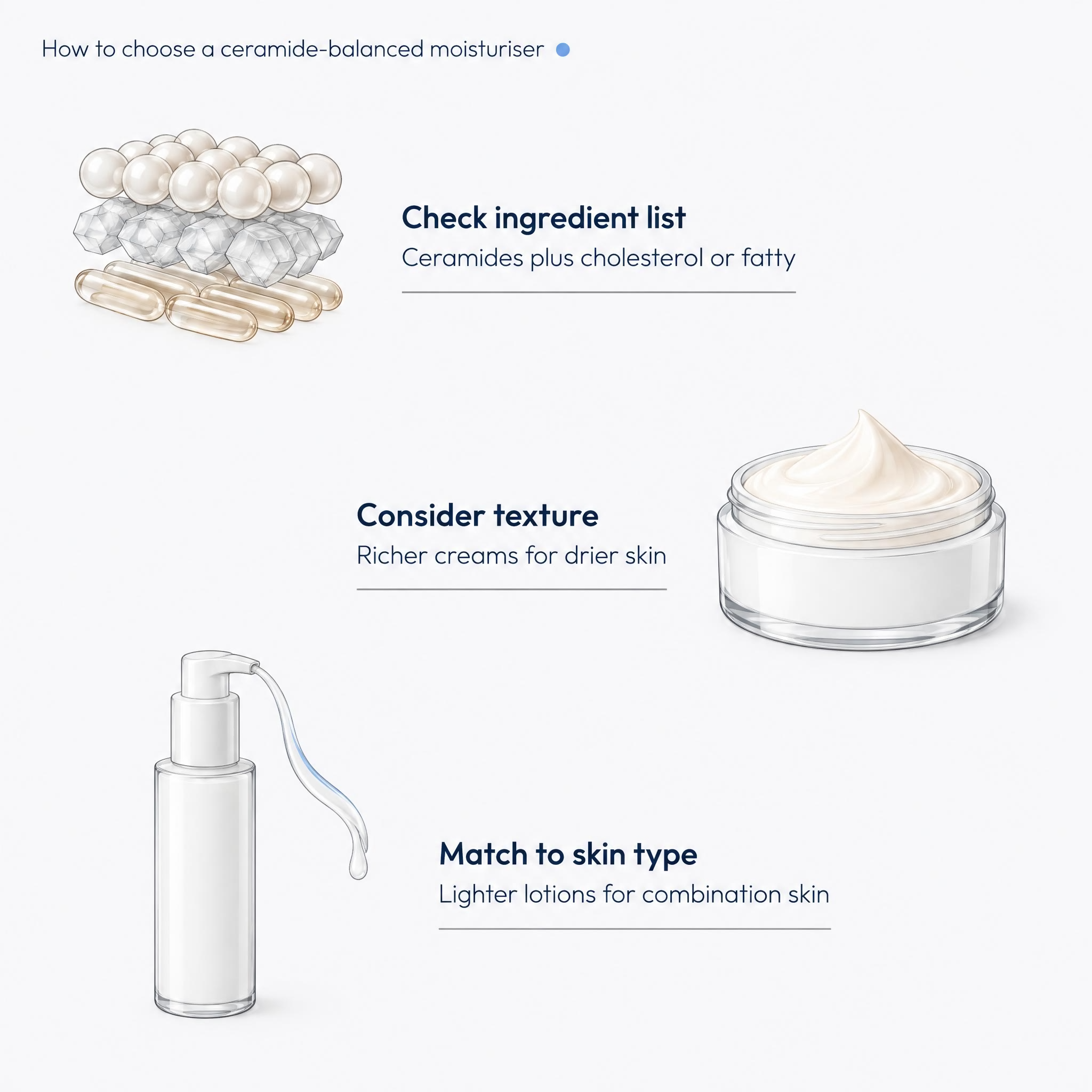
Look for moisturisers that list ceramides alongside cholesterol or fatty acids, rather than ceramides on their own. Texture matters too. Richer creams tend to suit drier, more compromised skin, while lighter lotions can suit combination skin that still needs barrier support. You can browse our full range of barrier-supporting moisturisers to compare formulas side by side.
If you are new to actives and unsure where ceramides fit in your routine, our guide on common skincare mistakes is a good place to check your current routine is not undoing your barrier's hard work.
Featured: ASAP Super C Complex
20% L-ascorbic acid inhibits tyrosinase activity, reducing melanin production and visibly evening skin tone with consistent use.
Shop NowCeramides are not just another skincare buzzword. They are a core part of how your skin barrier works, and the ratio matters as much as the ingredient itself. This is why professional brands formulate with cholesterol and fatty acids alongside ceramides, not ceramides alone.
Understanding this science puts you in a stronger position to choose products that truly support your skin, rather than ones that just look good on a label. If you would like to keep exploring how your skin works, visit our Skin Science Hub for more ingredient deep dives like this one.


